Paternoster
Chop House, London EC1
Conran
hits the spot again - and Clifford
goes back for seconds!
As
I arrived in Paternoster Square,
under the shadow of St Paul's, the
Cathedral's bells were going full
ding dong - a wild anarchic clangour
that echoed around the modern buildings,
challenging their contemporary conformity,
emphasising in sound the contrast
between the geometrical symmetry
of office windows with the Baroque
curlicues of Wren's masterpiece.
Sir Terence Conran knows a thing
or two about design, though I suspect
that even he would neither expect
nor wish to be compared with Wren
- his spatial world is a different
one, where utilitarian functionality
becomes handsome in its own right.
Very Sophoclean, that. Those gleaming
kitchens, exposed at one end of a
dining room, with grills that spout
orange flames alongside a cornucopia
of shellfish on ice, have become
a restaurant cliché. But, hang on,
it was the Conran team who were the
leaders of the modern (London) restaurant
revolution in the early nineteen-nineties.
If others chose to imitate, then
it is they who made it a cliché.
I liked this airy dining room with
its rich leather seating, slate floors
and simple oak tables 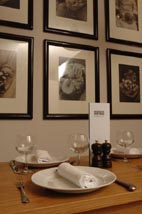
What
Conran also manages to do, is to
chime in with the mood of the moment.
The trend is moving away from the
fancy, back towards a more robust
style of cooking, using well sourced
local ingredients. That's fine if
you live in the country, but don't
worry, London has good markets and
suppliers and Chef Peter Weedon at
The Paternoster Chop House has gone
to great trouble to find fresh fish
from daily catches off the South
Coast, suckling pig from Lancashire,
oysters from West Mersea and from
Loch Fyne, while the 42 day dry aged
sirloin steak was the centrepiece
of my guest's dinner. This being
the game season,
I was delighted to find pigeon, partridge
and pheasant on this menu which changes
daily according to market availability.
Peter Weedon has
gone back to archival recipes in
his quest for authenticity, so the
emphasis is on grills and roasts
as well as traditional British favourites
such as potted veal, Barnsley chop,
steak and kidney pudding, fish pie,
and rice pudding (with baked damsons).
We started with Brundish onion tart,
a Suffolk version of quiche that
had miraculously creamy custard embedded
with well caramelised onion and a
good crisp pastry base. I had grilled
breast of wood pigeon with pickled
girolles which were just piquant
enough without masking their fungal
delicacy. The waiter warned me that
the pigeon breast would be pink.
The bird seemed to have recently
had a blood transfusion, which is
OK by me, but why do waiters have
to issue such warnings more as a
challenge: "It comes pink, sir
- (and don't even dream of asking
for it medium let alone well
done)"?
My main course
was a brilliantly executed stuffed
pig's trotter: braised in red wine,
bones removed, then stuffed with
the edible parts of itself enhanced
with chicken mousseline. It was served
on a bed of champ (mashed potato
and green stuff) with a delicious
thick gravy. My plate went back to
the kitchen clean. The properly aged
sirloin from Glen Fyne had that taste
of beef that's like no other. How
often is meat just a bland vehicle
for a cunning sauce? This was simply
grilled and had the true flavour
of the Highlands. We shared both
a side order of roast parsnips and
a companionable silence as we munched
our way thoughtfully through this
admirable provender.
|
Returned
for seconds
True
to my word, I went back again
because I wanted to try the
steak and kidney pudding. I
wasn't disappointed - the meat
was tender, the kidney/steak
ratio was perfect and the suet
crust was light and fluffy.
It comes served as an individual
pudding encircled by a rich
gravy, but there are no accompanying
vegetables so you need a couple
of side orders bringing the
cost of the dish to £21.50
which is perhaps a little excessive
for such homely fare.
To
start I tried the oysters -
very sea-fresh and properly
presented on a bed of ice.
To finish - rice pud - no nutmeg
flavoured skin, but very creamy
and perked up with delicious
damson confit
This has been my favourite
restaurant of the month. |
Puddings
are also traditional: my friend enjoyed
the "Cambridge burnt cream",
invented at Trinity College, and from
whom the French got the idea of crème
brûlée, or so the legend
goes. I was pleased to see quince on the menu, combined with apple in a
crumble which was nice, but would have been even better with proper custard instead
of clotted cream which was a unit of cholesterol too far. Next time I shall try
to
leave room for the sloe gin and Banbury cake -
you can't get more English than that.
The wine list is very comprehensive, with wines ranging
from a petit chateau Bordeaux at £15.00 to Haut Brion 1982 at £500.00. I
was sad to see not a single English wine in this otherwise very English restaurant,
but we greatly enjoyed a Portuguese red wine from the marvellous estate of
Quinto do Crasto at the very affordable price of £21.00.
This is a restaurant I could go back to time and time
again, there are so many classics on the menu that I'd like to try. In spite
of having opened only one month earlier, the place was almost full on a midweek
evening. The location is good, and the service (apart from that bloody warning!)
was excellent.
Clifford Mould November 2004
The Paternoster Chop House, Warwick
Court, Paternoster Square, London EC4
Tel: 020 7029 9400 Fax:
020 7029 9409 www.conran.com
Starters under £10.00; Grills and mains £15.00 - £20.00;
Puddings £5.50
Open Monday to Friday for elevenses, lunch and dinner
|